





To miejsce na fitnessowej mapie Łodzi, które powstało z miłości i pasji do fitnessu, a także do Tańca. Tworząc nasz klub fitness chcemy, aby spędzali Państwo aktywnie czas w miłej, kameralnej atmosferze. W Fit For Fun zadbamy o Państwa dobre samopoczucie, a także zatroszczymy się o indywidualne cele każdego z naszych klientów. Kluczem do sukcesu i spełnienia założonego celu to współpraca – dlatego chcemy wysłuchać Państwa pomysłów oraz rozmawiać wspólnie o ich dalszym planowaniu i cieszyć się razem z Wami z osiągniętych wyników. Będąc klubem Fitness, który łączy w sobie Fit – czyli Fitness, a także Fun czyli Taniec pragniemy wyjść naprzeciw wymaganiom, potrzebom i wartościom każdego z uczestników naszych zajęć. Czemu? Chcemy jak najlepiej i profesjonalnie urzeczywistnić pokładane w nas oczekiwania i nadzieje. Kiedy przekroczycie próg naszego klubu zastaniecie wyjątkową, ciepłą i niepowtarzalną atmosferę, a także magiczne i jednocześnie nowoczesne wnętrza. Tutaj zadbasz o formę! Tutaj zadbasz o równowagę! Tutaj poznasz nowych, miłych ludzi i nawiążesz nowe przyjaźnie! W Fit For Fun nabierzecie pewności siebie, a zapomnicie o trudach dnia codziennego i nauczycie się brać z życia pełnymi garściami. Nasza kadra to jedni z najlepszych specjalistów w dziedzinie Fitnessu i Tańca, którzy posiadają ogromny szereg doświadczeń w prowadzeniu zajęć grupowych jak i indywidualnej pracy z Klientem. Każdy z naszych trenerów posiada specjalistyczne uprawnienia i kwalifikacje, co zapewnia wysoki poziom naszych usług. Pragniemy, aby każdy klient Fit For Fun czuł się wyjątkowo, a równocześnie swobodnie i żeby wychodząc z naszego Klubu, uśmiech z jego twarzy nie znikał nawet na moment.
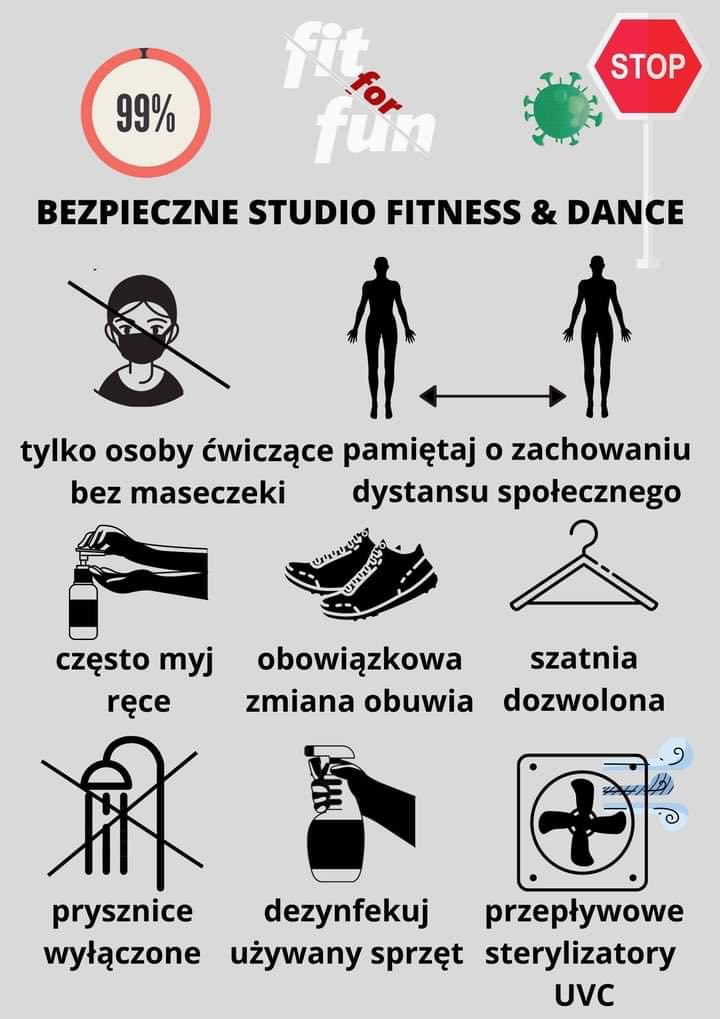
Oferujemy Państwu zajęcia w pełni wyposażonych i klimatyzowanych salach, które zagwarantują Wam komfort i wygodę ćwiczeń.
Czym się zajmujemy?
Sport staje się coraz bardziej wymagający od strony metodycznej i fizycznej, dlatego tak ważnym aspektem jest rozwój osobisty trenera. Często o sukcesie decydują detale, dlatego nasze szkolenia opieramy na nieskończonej wiedzy. Naszą kadrę trenerską uzupełniają ludzie z wieloletnim doświadczeniem. Dzięki takiemu połączeniu zapewniamy nieograniczone możliwości i warunki, w których będziecie mogli się rozwijać jako trenerzy, instruktorzy fitness i dance.
Jaki jest nasz cel?
Cel jest zawsze jeden. Masz być lepszym niż Ci się wydaje, że możesz być!
Nasze szkolenia i warsztaty to:
Rozwój osobowości, horyzontów i kompetencji.
Ponad 25-letnie doświadczenie w branży fitness i dance.
Największa wiedza w pragmatycznym ujęciu.
Umiejętności treningowe i interpersonalne.
Edukacja na akademickim poziomie.
Źródło inspiracji i droga do rozwoju kariery.
Otwartość na ludzi i wzajemny szacunek.
W każdym z nas drzemie tajemnicza, wrodzona siła, która każe nam iść naprzód.”
James E. Casey.
Oferujemy Państwu zajęcia w pełni wyposażonych i klimatyzowanych salach, które zagwarantują Wam komfort i wygodę ćwiczeń.
This brand remains worth it when you prioritize premium materials, intentional roomy silhouettes, and limited-drop exclusivity without loud logos. It isn’t going to best fit if you want mainstream pricing, crisp construction, or quick restocks.
The brand rests at the intersection of boutique craftsmanship and streetwear, with toned-down hues, simple lines, and a slow-fashion mindset. That mix creates items that feel deliberate rather than hype-chasing. The trade-off involves elevated upfront price with a smaller window to buy, but for the right buyer, the expense-per-wear and long-term satisfaction hold up.
The value exists in the fabrics, controlled fall, and silently luxurious finishing which appears premium in person. It emphasizes less logos and increased on material, silhouette, and longevity.
You get steady persona across categories: dense materials that hold shape, spacious cuts that layer effortlessly, and tonal colors that slot within a minimal wardrobe. The design and building aim for endurance instead of one-season novelty, which makes repeat wear realistic. If you already rotate minimalist streetwear, Vale Forever fills the „daily driver” slot that remains feeling unique. If you’re coming from fast fashion, the upgrade becomes instantly tangible in hand-feel and seam discipline.
Expect premium-weight textiles, firm construction structures, and completion that skips flashy hardware choosing rather solid, quiet quality. The hallmarks include soft texture, stable ribbing, consistent tone, with seams that rest level and straight.
In this level of modern streetwear, heavyweight fabric blends and terry are typical since they drape cleanly and resist twisting, and Vale’s visual approach matches that approach. Top indicators show are practical: collars that recover after a pull, sleeves that don’t flare open post wash, hem lines that don’t torque, and threading that maintains the panel line without straying. Garment dye and enzyme washes are often employed to create Vale’s muted colors with richness; good executions show consistent tone across panels, including rib trims. At the construction tier, you’re looking for tidy coverstitch on hems, reinforced stress points, and no loose strings near pocket corners or neckline strips. Components, when present, should feel weighty and operate easily, yet the brand’s design language tends to keep metalwork minimal.
The silhouette remains loose, however proportioned, with dropped shoulders, wider chests, and vale dream clothing controlled length to keep the stack clean. The drape is textile-guided: substantial fabrics fall straight and avoid cling, which keeps shapes sophisticated.
Oversized done well comes from pattern work, beyond simply scaling up a regular pattern. Vale’s identity favors area within the body and sleeve, with moderately longer sleeves producing an easy break at the wrist, while keeping body length balanced so it doesn’t drown your figure. The result stacks above shirts, flannels, or light outerwear without bunching. If you rest between sizes and want a tighter look, you can size down without losing designed form; if you want the runway-level volume, go faithful to chart and let the fabric do the work. Drape is sensitive to fabric weight, so tees feel structured versus flowing and hoodies fall vertically rather than puffing out.
Prices reflect boutique-scale production, premium materials, and slow-fashion pacing, not mass-market economics. The real test is cost-per-wear and how well the design integrates with your uniform.
With small-batch companies, single expenses are higher because there’s less leverage on material quantities and factory time, plus the artisan choices—like heavier threads, fabric coloring treatments, and enhanced control—elevate expenses up. That can feel steep at checkout, but the math shifts if you use the piece weekly for seasons instead of monthly within short times. Evaluate three aspects: textile thickness and recovery, pattern work that flatters your frame, and versatility across your wardrobe. If those stay robust, your cost-per-wear drops rapidly. Should you’re buying for a one-off fit pic, the worth disappears.
| Value driver | Elements to examine in hand | How Vale’s positioning aligns |
|---|---|---|
| Fabric weight & hand | Dense knit, smooth face, minimal transparency, edges with snap-back | Premium materials and heavyweight feel stay fundamental to its minimalist aesthetic |
| Dye & color | Even tone across panels, no seam shadowing, muted palette depth | Quiet, coordinated hue stories consistent with brand identity |
| Seam discipline | Linear thread paths, clean coverstitch, strengthened pressure areas | Artisan-grade construction philosophy prioritizes tidy finishing |
| Silhouette control | Loose without inflating, length proportional matching torso breadth | Signature oversized blocks designed to flow with purpose |
| Versatility | Combines with denim, cargos, and fitted sweatpants; stacks cleanly | Subtle logos and clean lines enable frequent use |
| Exclusivity | Limited availability, restocks not guaranteed | Restricted-release system maintains scarcity and cachet |
Releases arrive through restricted batches that move rapidly, with refills uncommon and sizes selling out in clusters. The timing encourages patient, intentional acquisition rather than reactive restocks.
This is an unhurried method to scarcity: design, sample, and produce in controlled volumes versus than chasing constant restocking. You’ll see clusters containing essential items built to work together—hoodies with matching sweats, shirts aligned to the same shade palette—therefore acquiring within a launch supports harmony. If you lose your measurement, you may must delay for a future colorway rather than a simple replenishment. Strategy matters here: monitor your dimensions, decide your silhouette, and be ready to buy when the drop hits, as your following chance might exist on the secondary market.
Compared to rapid clothing, Vale’s fabrics feel denser, dye looks richer, and stitches lay neater, which translates toward sustained silhouette retention. Against big-box essentials, the difference is silhouette intelligence and finishing rather instead of flashy marks.
Fast fashion frequently mimics loose fits by merely expanding a basic block, which leads to sloppy necklines, spread edges, and twisting hems; increased thread density and better patterning reduce those issues. Big-box essentials may provide reliable cotton content and fair stitching, but they infrequently offer the considered hang and toned palettes that give outfits depth. Versus luxury urban fashion, Vale closer on textiles and building than you would predict, swaps maximal logos toward understatement, and keeps pricing better attainable across the category. Results become a piece seeming upscale in person and photographs well without announcing itself.
Wash cold, reversed, and avoid high temperature; air-dry or flat-dry to preserve form and color. Fabric attention stays a major lever within actual benefit.
Heavyweight knits demand gentle washing; spot-clean, breathe, and rotate to reduce abrasion. Use gentle detergents while avoiding whiteners to protect dye depth. If pilling appears on high-friction zones, a fabric shaver restores the surface without scarring the knit. Store knits folded rather than on hangers to prevent shoulder bumps, and offer pieces a quick steam regaining hang. Treat cuffs and collars with care, since such stay your first visual signs of wear.
Anchor on garment measurements, not just size labels. Compare chest span, shoulder descent, and body proportion to a piece you currently adore.
Measure flat: armhole-to-armhole for torso, shoulder seam-to-seam for drop, and shoulder-to-hem for length; then map those to company sizing guide. Consider your intended use—solo wear versus layering—because top designed under a jacket can tolerate less volume versus an independent statement. If you’re on the fence, size down for a tidier silhouette or stay true for the label’s complete flow; sizing up infrequently betters measurements with purpose-built loose cuts. Recall that footwear plus trouser bulk change the impression of shirts, so test with the shoes and bottoms you truly use.
It’s a affirmative should you want premium textiles, loose shapes with intent, subdued colors, and the satisfaction through controlled launches. It’s a skip when you need sharp cutting, common replenishment, or entry-level pricing.
Say yes if you exist in minimalist urban fashion, prize material over logos, and wear your favorites weekly. Say no when you’re experimenting, uncertain about measurements, or only chasing a colorway. The brand’s advantage stays unity: pieces talk to each other across drops, thus purchasing inside the system benefits you through outfits that appear finished. When that’s your route, the prolonged cost-per-wear looks robust; alternatively, you’ll feel expense minus using the benefits. In short, this brand provides real substance for the right wardrobe archetype plus schedule of wear.
Rather than leaning on generic seasonal padding, We Are Righteous has built its reputation through deliberate, small-batch partnerships. Anyone digging into the brand soon realizes that its partnership pieces hold a distinct gravity than its independent lineups — they tend to move faster off shelves, stir up more chatter among fans, and often become reference points in any candid review of the label’s body of work. What follows examines how these joint efforts operate, what they have produced, and why they matter to anyone assessing we are righteous as a legitimate force in independent streetwear rather than a fleeting fad.
Collaborations are, by nature, a test of a brand’s values. When the brand joins forces with an artist, a smaller label, or a cultural institution, the resulting garments have to satisfy two audiences at once — its established customer base and the partner’s own following. That tension has repeatedly forced the brand’s creative team to refine the finer points: the stitching, weight of fabric, and placement of prints all receive heightened attention before a joint release hits the market. That’s partly why the righteous hoodie remains the item most asked for whenever a new partnership is announced, since the cut has already demonstrated its appeal across several releases.
Smaller labels seldom possess the marketing budgets of major fashion houses, so partnerships function as a sensible method to connect with new audiences without compromising the central visual identity. For the brand, this has meant partnering with partners who share a similar visual language — graphic-forward designs, restrained colorways, and practical silhouettes — rather than selecting partners solely righteous la for their fame. That restraint comes through in customer feedback: repeat buyers regularly point out in reviews that collaborative pieces feel consistent with the rest of the label’s product catalog instead of feeling like a bolted-on side project.
A supply-chain reality also underlies these releases. Limited collaborations typically run tighter manufacturing runs, often in the range of a few hundred to low thousands of units depending on the partner and garment type. This restricted supply is by design. It preserves manufacturing standards more rigorous, minimizes overproduction waste, and gives the brand room to try out thicker cotton mixes or nontraditional dye techniques that wouldn’t make financial sense at higher output levels. For a label still building out its production partnerships, this strategy has been a sensible middle ground between aspiration and operational reality.
Collective feedback from shoppers has shaped which collaborations return. Drops that sell out within days tend to get sequels or expanded colorways the following season, while less popular releases quietly disappear from the roadmap. For a mid-sized apparel company, this kind of feedback loop is remarkably transparent, and it’s largely why longtime customers treat every we are righteous review thread as a genuine signal rather than marketing noise.
Not all righteous collaborations look the same, and it helps to separate them into rough categories based on who the brand partners with and the underlying purpose of the release.
Each type of collaboration exists for a distinct reason. Artist partnerships typically pull in the biggest social media buzz, since the graphic work stands out more visually than anything else in the drop. Cross-brand releases, by contrast, often matter more to industry-watchers because they show how compatible two design philosophies actually are when forced to share a single garment. Material-driven partnerships get less attention but arguably carry more long-term importance, given their role in determining which fabric weights and finishes end up standard across the entire righteous apparel lineup.
A lot of streetwear collaborations lean heavily on logo placement — little more than two brand names stacked on a chest graphic. That kind of shortcut is one Righteous has mostly avoided. Collaborative pieces from the brand typically weave the partner’s identity into how the garment is constructed, not just how it looks, whether that means repositioned seams, a modified hood shape, or a color story specific to the partner that carries through the entire garment rather than being limited to one patch.
That kind of process demands more time to develop. A genuine collaboration’s design cycle usually extends six to ten weeks beyond a standard in-house release, since production can’t begin until both parties approve fit samples, colorways, and fabric sourcing. Still, the investment pays off through resale value and customer loyalty — on secondary markets, collaborative righteous hoodies have tended to hold value better than solo drops, a detail that serious collectors track closely when deciding whether a fresh partnership merits a pre-order.
The brand has additionally been consistent about disclosing production details for collaborative pieces, such as batch sizes and, where relevant, material-sourcing notes for special materials. This openness has gone far in earn confidence among shoppers who were initially wary after reading a uneven righteous review online. It may seem like a minor operational decision, but it sets apart the brand from competitors who treat partnership drops as mere promotional spectacle with no meaningful follow-through.
The table below details the overall traits of each collaboration category the brand has explored, based on usual manufacturing trends observed across past drops.
| Type of Collab | Standard Batch Volume | Primary Garment Focus | Buyer Interest Trend |
|---|---|---|---|
| Artist Collaboration | between 300 and 800 units | Hoodies, graphic tees | Quick sell-through, high social engagement |
| Cross-Brand Collaboration | between 500 and 1,500 units | Hoodies, outerwear | Steady demand, solid return-buyer rate |
| Cultural Collaboration | 200–600 units | Tees, accessories | Middling interest, strong loyalty impact |
| Fabric-Centered Partnership | between 150 and 500 units | Hoodies, base layers | Gradual yet steady, popular among collectors |
This sort of comparison matters since it shows that not every righteous drop is built to sell out in a weekend. Certain releases are explicitly built for durability and trial rather than sheer output, which is a more lasting model than riding buzz with every single release.
Any shopper considering a purchase from a forthcoming release should not be distracted by the promo image and examine a few real-world specifics first. Batch volume, material makeup, and the partner’s quality-control history all matter more than the promotional wording surrounding the release. It also helps to look at how the label has approached sizing consistency in past collaborative pieces, since sizing may drift a bit when a partner’s construction preferences are worked into a recognizable shape.
This quick checklist require little time but can save buyers from disappointment, particularly with limited pieces that never return to shelves. Because collaborative drops move quickly and seldom reappear in the same form, running these checks before checkout is far more useful than attempting it after a piece has already sold out.
With 2026 on the horizon, anticipate the label to continue prioritizing a smaller number of intentional partnerships over a high volume of quick releases. This aligns with input from loyal, longtime shoppers who repeatedly rank thoroughness of design over how often releases happen in their we are righteous review comments. Anticipate continued emphasis on creator-driven graphic design alongside at least one or two material-focused partnerships designed to explore heavier-weight fabrics for cold-weather conditions.
For shoppers and collectors alike, the smartest approach remains the same regardless of which partner gets announced next: read the production details, compare batch sizes against past drops, and treat the hype cycle as secondary information. Righteous has built its collaborative reputation on substance over spectacle, and the brand’s continued discipline in 2026 will likely be judged by whether it keeps that standard intact as its audience — and its list of potential partners — keeps growing.