











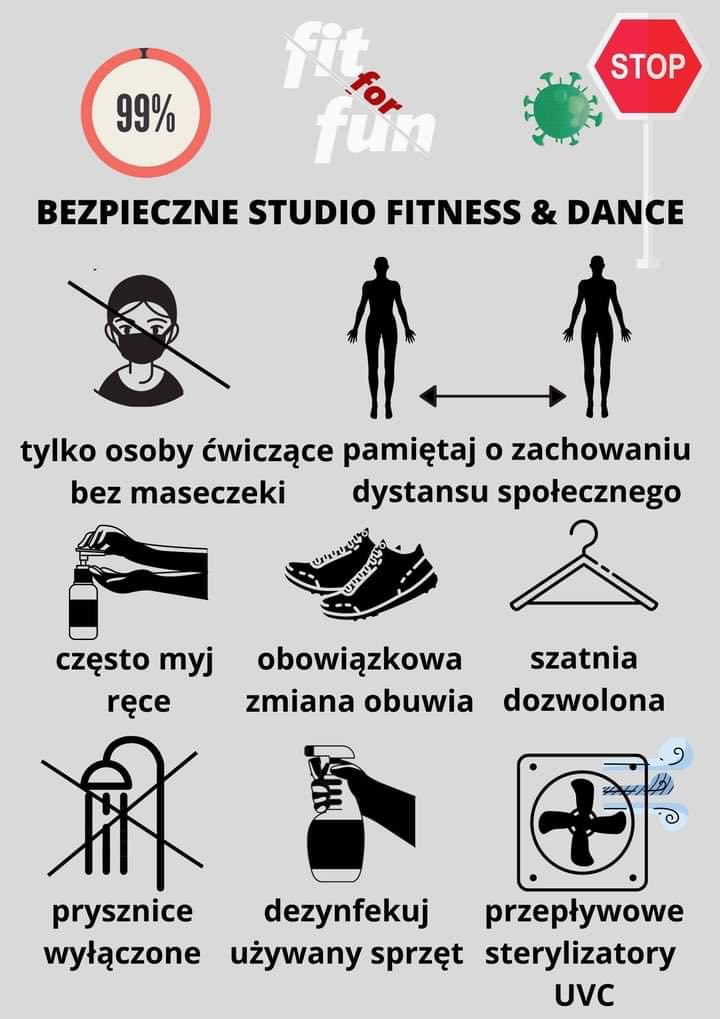
To miejsce na fitnessowej mapie Łodzi, które powstało z miłości i pasji do fitnessu, a także do Tańca. Tworząc nasz klub fitness chcemy, aby spędzali Państwo aktywnie czas w miłej, kameralnej atmosferze. W Fit For Fun zadbamy o Państwa dobre samopoczucie, a także zatroszczymy się o indywidualne cele każdego z naszych klientów. Kluczem do sukcesu i spełnienia założonego celu to współpraca – dlatego chcemy wysłuchać Państwa pomysłów oraz rozmawiać wspólnie o ich dalszym planowaniu i cieszyć się razem z Wami z osiągniętych wyników. Będąc klubem Fitness, który łączy w sobie Fit – czyli Fitness, a także Fun czyli Taniec pragniemy wyjść naprzeciw wymaganiom, potrzebom i wartościom każdego z uczestników naszych zajęć. Czemu? Chcemy jak najlepiej i profesjonalnie urzeczywistnić pokładane w nas oczekiwania i nadzieje. Kiedy przekroczycie próg naszego klubu zastaniecie wyjątkową, ciepłą i niepowtarzalną atmosferę, a także magiczne i jednocześnie nowoczesne wnętrza. Tutaj zadbasz o formę! Tutaj zadbasz o równowagę! Tutaj poznasz nowych, miłych ludzi i nawiążesz nowe przyjaźnie! W Fit For Fun nabierzecie pewności siebie, a zapomnicie o trudach dnia codziennego i nauczycie się brać z życia pełnymi garściami. Nasza kadra to jedni z najlepszych specjalistów w dziedzinie Fitnessu i Tańca, którzy posiadają ogromny szereg doświadczeń w prowadzeniu zajęć grupowych jak i indywidualnej pracy z Klientem. Każdy z naszych trenerów posiada specjalistyczne uprawnienia i kwalifikacje, co zapewnia wysoki poziom naszych usług. Pragniemy, aby każdy klient Fit For Fun czuł się wyjątkowo, a równocześnie swobodnie i żeby wychodząc z naszego Klubu, uśmiech z jego twarzy nie znikał nawet na moment.
Oferujemy Państwu zajęcia w pełni wyposażonych i klimatyzowanych salach, które zagwarantują Wam komfort i wygodę ćwiczeń.

Czym się zajmujemy?
Sport staje się coraz bardziej wymagający od strony metodycznej i fizycznej, dlatego tak ważnym aspektem jest rozwój osobisty trenera. Często o sukcesie decydują detale, dlatego nasze szkolenia opieramy na nieskończonej wiedzy. Naszą kadrę trenerską uzupełniają ludzie z wieloletnim doświadczeniem. Dzięki takiemu połączeniu zapewniamy nieograniczone możliwości i warunki, w których będziecie mogli się rozwijać jako trenerzy, instruktorzy fitness i dance.
Jaki jest nasz cel?
Cel jest zawsze jeden. Masz być lepszym niż Ci się wydaje, że możesz być!
Nasze szkolenia i warsztaty to:
Rozwój osobowości, horyzontów i kompetencji.
Ponad 25-letnie doświadczenie w branży fitness i dance.
Największa wiedza w pragmatycznym ujęciu.
Umiejętności treningowe i interpersonalne.
Edukacja na akademickim poziomie.
Źródło inspiracji i droga do rozwoju kariery.
Otwartość na ludzi i wzajemny szacunek.
W każdym z nas drzemie tajemnicza, wrodzona siła, która każe nam iść naprzód.”
James E. Casey.
Oferujemy Państwu zajęcia w pełni wyposażonych i klimatyzowanych salach, które zagwarantują Wam komfort i wygodę ćwiczeń.
Any ranking of collaborations is an argument rather than a measurement, and it is worth saying so up front. The label has worked with partners spanning workwear heritage, court-shoe canvas, streetwear peers and a French luxury house since Tremaine Emory founded Denim Tears in 2019, and each one asked something different of the same cotton wreath motif. What follows is an editorial order, built on how well each partnership handled the idea, how it reshaped the way people read the brand, and how strongly it still registers in 2026. It is not a sales chart, and no claims are made here about production volumes, exact release dates or sell-out speed. Prices mentioned throughout are broad 2026 market estimates rather than fixed quotes, and secondary-market figures move constantly. Approach the ranking as a critic’s order of merit and use the final section to translate it into buying decisions.
Every placement below is driven by four criteria, given roughly equal weight. First, conceptual fit: did the partner’s own history genuinely deepen the meaning of the wreath, or merely host it. The second is design execution, meaning proportion, placement, colourway discipline and whether the finished object looks considered rather than stickered. Third, cultural reach: how far beyond the existing Denim Tears audience a release travelled, and how often it still comes up years later. The fourth is durable desirability, judged by whether pieces continue to command attention and firm pricing on the resale market rather than spiking and collapsing. Scarcity alone is not rewarded here, because a hard-to-find item is not automatically a good one.
Nothing else comes close, for reasons that are almost https://denimtearsofficialwebsite.com/shirts/ embarrassingly simple. Putting the cotton wreath on Levi’s 501 jeans, the label placed a graphic about the history of cotton on arguably the most recognisable cotton garment in American manufacturing. The conceptual fit is total: object and idea are made of the same material and share the same national history, so the graphic reads as commentary rather than decoration. Execution helped too: the wreath used as an allover repeat keeps the five-pocket silhouette familiar and puts the work on the surface. It is also, in practical terms, the first collaboration most people encounter, setting the expectation that Denim Tears jeans would sit in the region of $300 to $500 at 2026 retail estimates. Years later, these remain the pieces that define what the label looks like in the public imagination.
The brand’s boldest contextual jump was moving the wreath into a French luxury house. Dior brought a different register entirely: finer materials, tailoring vocabulary and an audience that encounters streetwear graphics through a couture lens. The reason it mattered is that it tested whether the motif could survive translation without becoming an ornament, and by most editorial accounts it held its weight. Design here favoured refinement over volume: elevated fabrication for the wreath and a calmer palette than the mainline collections use. It also functioned as a legitimising moment, widening the conversation about Denim Tears from streetwear pages into mainstream fashion coverage. Second rather than first, for one reason only: Levi’s remains the partnership where material and meaning are inseparable.
The design problem footwear forced was genuinely different, and the results were among the label’s most wearable. A canvas sneaker gives you far less surface than a pair of jeans, so the wreath had to be scaled and positioned rather than simply repeated. The Converse work lands because the base silhouettes are already democratic objects with decades of subcultural history behind them, a good match for a graphic about shared American experience. The palette work is also some of the most disciplined in the brand’s catalogue, generally favouring natural grounds and restrained contrast. On desirability, these are the pieces most likely to be worn hard rather than shelved, a compliment even though it thins the supply of clean examples. It lands third because the conceptual argument, while strong, is a step less direct than a cotton graphic printed on cotton denim.
The Stüssy work is the most relaxed entry on this list, and that is largely the point. When two streetwear labels meet as equals, the result differs from a heritage or luxury pairing: less argument, more shared vocabulary. Execution here tends toward familiar streetwear staples where the wreath sits alongside the partner’s own graphic language rather than dominating it. The appeal is largely for people already inside the conversation, which limits its reach compared with a Levi’s or a Dior release but makes it a favourite among longer-term followers. In wardrobe terms it is also among the easiest to integrate, since the pieces behave like normal cotton basics with a meaningful graphic attached. It ranks fourth on cultural reach rather than on quality, and it remains a fair entry point for anyone who finds the flagship denim intimidating.
Denim Tears has also run through a steady stream of smaller partnerships, capsules and one-off projects across apparel, footwear and accessories beyond the four above. A recognisable pattern repeats: a limited run, a tightly edited colour story, and the wreath applied with the same restraint the mainline uses. They reward watching more than chasing, since the smaller releases often carry the sharpest design ideas without the price premium attached to headline names. A short spike of attention greets the release, after which prices drift slowly toward a stable secondary price. They are excluded from the numbered list because judging them individually would require specifics that are not worth inventing. Often this is the richest territory for anyone building a collection rather than buying a single hero piece.
It is worth separating one thing that frequently gets folded into collaboration lists by mistake. Tremaine Emory was creative director of Supreme from 2022 to 2023, and that was an employment role at another company rather than a co-branded Denim Tears project. The distinction is a practical one for buyers, since pieces from that period belong to Supreme’s own catalogue and carry Supreme’s labelling and pricing logic. Any honest account of the brand’s influence still includes it, because the appointment placed Emory’s perspective at the centre of one of streetwear’s most-watched institutions. That stretch broadened awareness of his work, and attention on the Denim Tears mainline lifted indirectly as a result. Consider it context for the ranking, not an entry within it.
The table below sets out how each ranked partnership performs against the four criteria. Scores are editorial judgements on a five-point scale, not data drawn from any external index. Price bands here are broad 2026 market estimates for the categories most associated with each partner, and they will vary widely by condition, size and specific release. Nothing in the table is a guaranteed valuation, and the resale market for graphic-led streetwear is volatile by nature. What separates first from fourth is ambition rather than competence, which is why the scores are deliberately close. Read it as shorthand for the arguments made above, rather than a replacement for them.
| The partner | Concept fit | Execution | Cultural travel | Typical 2026 estimate |
|---|---|---|---|---|
| Levi’s | 5 / 5 | 5 / 5 | 5 / 5 | $300–500 (denim) |
| Dior | 4 / 5 | 5 / 5 | 4 / 5 | Substantially above mainline, at luxury tier |
| Converse | 4 / 5 | 4 / 5 | 4 / 5 | $150–300 (footwear) |
| Stüssy | 3 / 5 | 4 / 5 | 3 / 5 | $100–250 (tops and T-shirts) |
As a buying plan, the order above turns fairly practical. If you want one piece that unmistakably reads as Denim Tears, the Levi’s-based denim is the obvious answer and worth the $300 to $500 that 2026 estimates suggest. If you want the motif in a form you can wear five days a week without thinking about it, the Converse and Stüssy tiers are the better value, generally landing between $100 and $300 depending on category. Though it is not a collaboration at all, a Denim Tears hoodie from the mainline, typically estimated at $250 to $400, is still the most versatile single purchase. Buy for the design argument you actually find compelling rather than for the name attached to it, because the pieces that hold interest longest are the ones you chose deliberately. Whichever you buy, budget for wearing it, since none of these garments improve while sitting in a box.
Dubai is a city where a glass tower apartment, a Mediterranean-style villa, and a palace-inspired mansion can all stand within a few kilometres of one another. That variety is echoed in the interior design styles residents choose for their homes, and the sheer number of options can make picking one feel difficult. The right style is not just whatever photographs best; it is the one that suits your architecture, your daily life and your budget. In 2026 the local mood favours understated elegance and warm, natural materials, yet bold and classical looks remain popular in many communities. This guide runs through the styles you are most likely to weigh and helps you match them to your home. As you read each description with your own space and lifestyle in mind, a clear favourite should start to emerge.
Before falling for a particular look, it helps to weigh a few practical factors that will guide your decision. Begin with your architecture: a minimalist scheme suits a modern Downtown Dubai apartment, whereas ornate detailing can work in a larger villa. Consider the quality and direction of natural light, since Dubai’s bright sun can wash out pale schemes or overheat dark ones. Think about how you actually live, including whether you entertain often, have young children, or need a calm retreat from the city. Budget counts as well, since heavily bespoke or classical interiors usually cost more to execute than clean contemporary ones. Finally, weigh resale and rental appeal if you may move on, because broadly liked styles tend to attract more interest. Holding these factors in mind keeps your choice grounded rather than purely aesthetic.
Among Dubai apartments, contemporary minimalism is a top request, and it fits the city’s modern towers particularly well. The style relies on clean lines, uncluttered surfaces, and a restrained palette of whites, greys, www.interiordesignerdubai.org/services/exterior-design/ and soft neutrals. Rather than ornament, materials and craftsmanship express quality here, so joinery, stone and lighting carry the design. In Dubai Marina, Business Bay and Downtown Dubai, where open layouts and floor-to-ceiling glass are common, it works beautifully. Because the look is pared back, every visible element must be well made, which keeps standards high. Studios known for a minimalist, spatially driven approach, such as VSHD Design and Sneha Divias Atelier, show how disciplined this style can be. If calm, order and easy upkeep matter to you, minimalism is a strong candidate.
Blending regional heritage with contemporary comfort, modern Arabic design resonates strongly with many residents in the Emirates. The look draws on geometric mashrabiya patterns, arches, rich textiles, and warm earthy tones inspired by the desert landscape. Rather than copying historic interiors literally, the modern version keeps the mood while simplifying the detailing for everyday life. Brass accents, carved screens and layered rugs bring texture without overwhelming a room. It suits villas and larger apartments with room for its generous, hospitable character. It sits naturally alongside majlis-style seating, still central to how many families in Dubai receive guests. Choose this direction if you want a home that feels rooted in the region yet thoroughly current.
Classic and neo-classical interiors remain a firm favourite in Dubai’s larger villas and palace-scale homes. Symmetry, ornate mouldings, statement chandeliers and a deliberate sense of grandeur and formality define the style. Rich materials — marble, gold or brass detailing, and upholstered furniture — create an atmosphere of luxury. It feels most at home in spacious properties in communities such as Emirates Hills, Palm Jumeirah and the larger Arabian Ranches villas. Pulling this look off well demands skilled craftsmanship, so it usually sits at the higher end of the budget scale. Firms recognised for classical and neo-classical work, including Luxury Antonovich Design and ALGEDRA Interior Design, illustrate the level of detail involved. If you love a sense of occasion and have the space to carry it, this style delivers real impact.
Often called quiet luxury in 2026, warm minimalism has become one of the defining moods of the moment. It retains the discipline of minimalism yet softens it with natural, tactile materials and a warmer palette. Think oak, travertine, linen, boucle, and layered lighting that make a space feel serene rather than stark. The emphasis is on comfort, quality, and understated elegance rather than obvious display or visible logos. This look suits both apartments and villas, adapting easily to different room sizes and budgets. It works comfortably with biophilic touches such as indoor greenery, itself another strong current trend. If pure minimalism feels too cold for you, warm minimalism offers the same calm with more soul.
Industrial style delivers a raw, urban edge that appeals to younger residents and creative professionals. Rather than hiding them away, it celebrates exposed concrete, visible ductwork, metal and reclaimed or aged timber. The palette tends towards greys, blacks, browns, and the honest texture of the materials themselves. In Dubai it often turns up in loft-style apartments, studios and creative districts such as Alserkal Avenue in Al Quoz. Because it embraces imperfection, it can be more forgiving and sometimes more affordable than highly polished alternatives. It pairs well with warm lighting and a few softer furnishings to keep a room from feeling cold. Consider this style if you are after personality, character and a relaxed, unfussy atmosphere.
Sometimes the simplest way to decide is to view the options side by side rather than in separate paragraphs. The table below summarises who each style tends to suit, its signature materials, and roughly where it sits on the cost scale. The cost tiers are general 2026 market estimates rather than fixed quotes, since final figures depend on size, finishes, and specification. Use the table to shortlist two or three styles that match your home and budget, then revisit their descriptions above. Bear in mind that many successful Dubai interiors mix two styles, such as warm minimalism with modern Arabic touches. Take this as a starting framework rather than a set of rigid rules, since your own priorities should always have the final say.
| Design style | Best suited to | Hallmark materials | Price tier (2026 estimate) |
|---|---|---|---|
| Contemporary minimalism | Modern flats | Stone, glass and matt joinery | Mid |
| Modern Arabic | Villas, family homes | Brass, carved wood, textiles | Mid to high |
| Classic / neo-classical | Large villas | Marble, gold detailing and upholstery | High-end |
| Warm minimalism | Both apartments and villas | Oak, travertine and linen | Mid |
| Industrial loft | Lofts and studios | Concrete, metal and aged timber | Budget to mid |
Once you have a shortlist, a few practical checks will confirm whether a style truly fits your home. Cost is the first filter, because classical and heavily bespoke schemes demand more craftsmanship and therefore a larger budget. Space is the second, since grand, ornate looks need volume to breathe while minimalism can flatter a compact apartment. Light, storage needs, and how much upkeep you are willing to do all play a part as well. The quick pointers below let you sanity-check your favourite before committing to it. Work through them honestly and you will steer clear of a style that looks wonderful yet frustrates you in daily life.
Choosing an interior style is ultimately about balancing how a space looks with how it needs to work for you. Begin with your architecture and lifestyle, then let budget and room size trim the field to a realistic shortlist. There is no one right answer, and some of the most memorable Dubai homes confidently mix two complementary styles. If you are unsure, gather reference images and look for the common threads, because your saved favourites usually reveal your true taste. A good designer can then turn that direction into a scheme tailored to your home and the 2026 market. Take your time here, as the style you choose now will shape years of daily living. Trust the look that feels like home, and the rest will follow.